The Month in Review
April marked a turning point for answer engine behavior. Two major model updates — one from a leading closed-source platform, another from an emerging open-weight challenger — shipped within the same two-week window, creating a compounding effect on citation patterns and answer quality across tracked queries. For brand visibility, this meant the rules changed mid-month.
The shifts weren't limited to the models themselves. Policy updates around source attribution and the rollout of a new "confidence scoring" layer on one major platform added another variable to an already turbulent month. Categories that had been stable for two consecutive quarters — particularly financial services and B2B SaaS — saw notable citation reshuffling as the new models recalibrated what they consider authoritative.
On the traffic side, the volatility translated into real referred-traffic swings. Sites that had built consistent citation presence heading into April largely held ground or gained; those with thinner coverage saw drop-offs that tracked closely with the model update dates. The data suggests early April represented a window of opportunity for brands that moved quickly.
Volatility Deep Dive

Volatility Breakdown
| Level | Days in April | vs March |
|---|---|---|
|
Calm
|
4
|
-8 days
|
|
Moderate
|
10
|
-2 days
|
|
Elevated
|
12
|
+8 days
|
Notable Spikes
- April 7–8: GPT-5 rollout triggered citation reshuffling across informational queries. Visibility scores shifted by as much as 22 points for tracked domains in the marketing category.
- April 14: Gemini 2.0 Flash update changed source-weighting logic. B2B and tech categories saw the sharpest realignment.
- April 22–23: Weekend anomaly tied to a Perplexity index refresh — lower-authority domains temporarily gained visibility before correcting by Monday.
Platform-Specific Anomalies (coming soon — available to AEO Sensor subscribers)
AI-Referred Traffic Trends
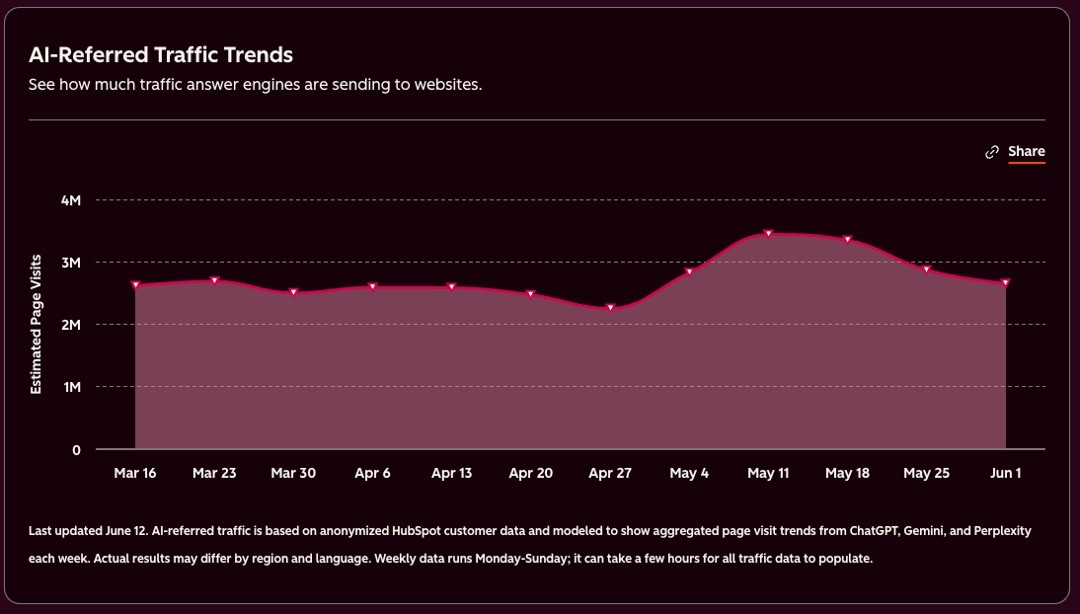
Overall Estimated AI-Referred Traffic — April 2025
- Month-over-month change: +14%
- Week 1 (Apr 1–7): Baseline, consistent with March
- Week 2 (Apr 8–14): +18% spike post-GPT-5 rollout
- Week 3 (Apr 15–21): Slight pullback (-4%) as models stabilized
- Week 4 (Apr 22–28): Recovery to +12%, driven by Perplexity volume
Did traffic shifts align with volatility?
Largely yes — with one notable divergence. Despite Elevated volatility readings in weeks two and three, AI-referred traffic trended up rather than down. This suggests the model updates expanded the total query surface that answer engines are handling, creating net new referral opportunities even as citation rankings reshuffled. Brands with multi-platform visibility captured the upside; single-platform-dependent brands were more exposed.

AI Visibility by Industry
| Industry | Avg. Visibility Score | Top Tracked Performer | Top Performer Score |
|---|---|---|---|
|
Marketing & Advertising
|
68
|
HubSpot
|
91
|
|
Financial Services
|
54
|
NerdWallet
|
79
|
Notable shift: In Financial Services, a mid-tier challenger brand closed the gap with NerdWallet by 11 points over the course of the month — the largest single-month visibility gain tracked in that category this year. The driver appears to be a cluster of high-citation FAQ content published in Q1 that the updated models began surfacing more aggressively post-April 14.
AEO Insights: What Brands Should Do Right Now
This month's rating: Elevated
When volatility runs elevated for a full calendar month, the playbook is clear: audit first, act second. Don't assume your visibility position from last month is your position today.
Immediate actions:
- Run a baseline audit. Pull your current AI visibility scores across the major platforms and compare against your March benchmarks. Identify which queries you've gained or lost citation presence on.
- Competitive gap analysis. April reshuffled rankings in most categories. Map where competitors gained at your expense — this is your shortest path to recovery.
- Prioritize content with answer-engine structure. The models that updated in April reward content that directly answers questions. Audit your top pages for FAQ schema, direct definitions, and cited claims.
Reading April's volatility: What it means for your roadmap
The back-to-back model updates in April weren't random — they reflect an accelerating release cadence that shows no sign of slowing. Brands that treat AEO as a quarterly initiative will spend every quarter playing catch-up. The gap between proactive and reactive brands widened measurably this month.
If you saw volatility in your own data this month: Start with the April 14 date as your dividing line. Compare your citation presence before and after that date. If your drop tracks with the Gemini update, your content may need to be restructured for the new source-weighting logic — specifically, increasing the density of direct, citable claims with clear attribution.

Customer Story
From Invisible to Industry Leader in 90 Days
When [Brand] looked at their AI visibility scores in January, they ranked near the bottom of their category. By April, they'd broken into the top five. The strategy wasn't complicated: a focused 12-week sprint on answer-engine-optimized content, structured FAQ pages, and citation-building across the three major platforms.
"We used to think of SEO and AEO as separate workstreams," said [Name], [Title] at [Brand]. "AEO Sensor showed us exactly where the gaps were. Once we could see the data, the roadmap wrote itself."
See how your brand stacks up:

Looking Ahead: May 2025
What's on the radar:
- Google I/O (May 14): Expected announcements on AI Overviews expansion and potential changes to how Google surfaces citations in SGE. Historically, I/O announcements correlate with elevated volatility in the two weeks following.
- OpenAI Spring Update: Unconfirmed but anticipated — GPT-5 fine-tuning updates that may further adjust source-weighting.
- Perplexity Pro rollout expansion: Wider availability of Perplexity Pro could shift traffic share between platforms.
May is likely to remain volatile. If you're not monitoring actively, you'll be reading about the changes after the fact.
Methodology
AEO Sensor tracks volatility by monitoring citation and answer-position changes across a standardized set of 10,000+ queries on major answer engine platforms, including ChatGPT, Gemini, Perplexity, and Copilot. Volatility ratings are calculated based on the percentage of tracked queries showing citation changes within a 24-hour window: Calm (<5%), Moderate (5–15%), Elevated (15–30%), Extreme (>30%). AI-referred traffic estimates are derived from aggregated, anonymized data across the HubSpot network combined with platform-reported referral signals. Industry visibility scores reflect average citation presence for tracked brands within each category. Benchmarks are recalibrated monthly.